
Before you ask AI to tell you anything about yourself, pause.Before you ask AI to tell you anything about yourself, pause.
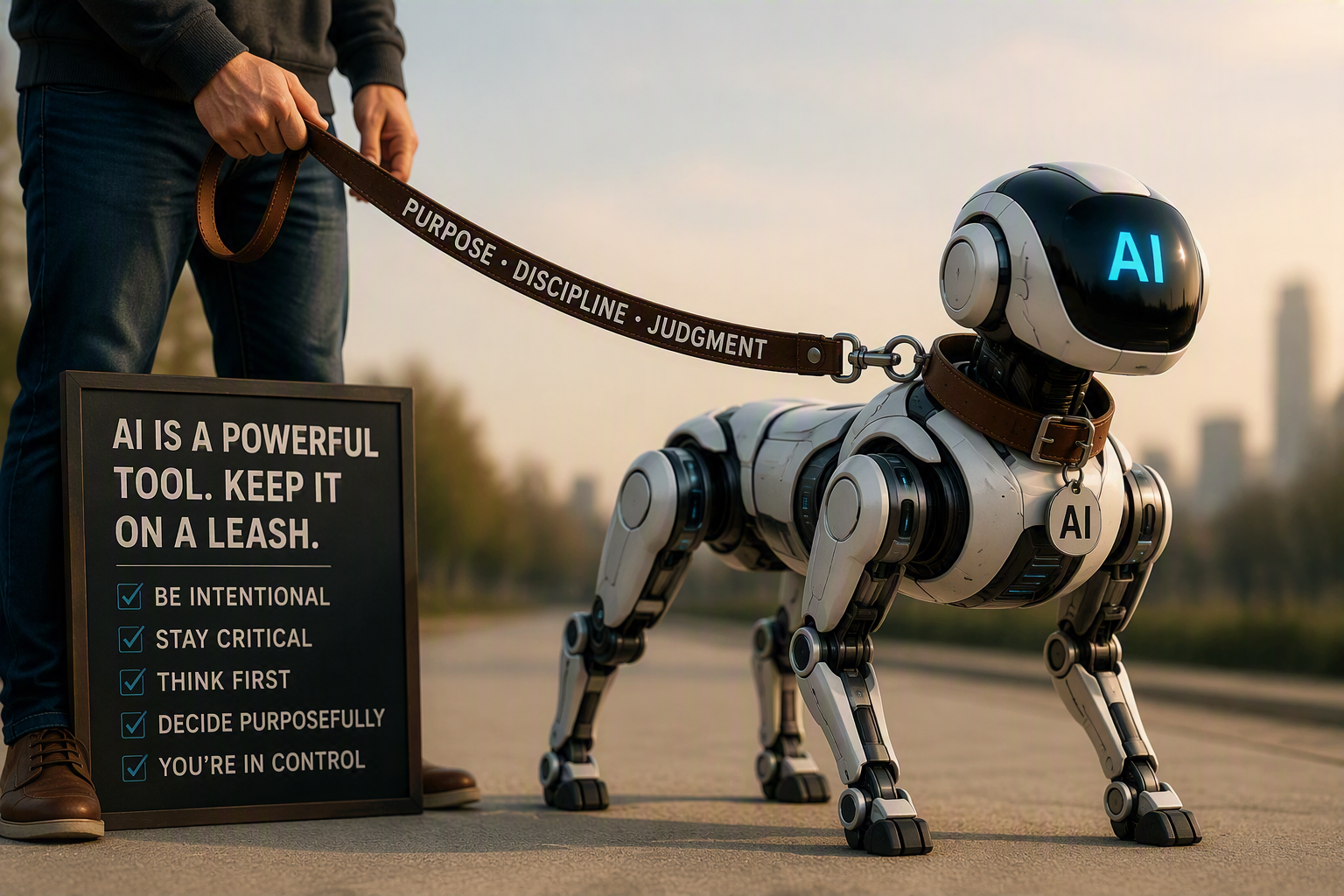
We can’t control AI. Founders and thinkers such as Michael Bhaskar and Mustafa Suleman (The Coming Wave) have written extensively about its impact and scale. It is impossible for individuals to make a large-scale impact on where this technology is headed. What we can do, and what we must do, is make conscious and deliberate decisions about when, why, and how we interact with AI.
What are the consequences if we don’t?
I won’t ask Copilot or Claude to answer that question for me because I already know the consequences and am experiencing them. Relying on AI is not always being resourceful, efficient, or effective. Sometimes it is simply being lazy. It tells me that it’s OK to stop thinking, stop reflecting, and stop being critical and analytical of a world that is advancing at lightning speed.
This series explores AI’s impact on the self and discusses how to put a leash on technology so you don’t lose the essential skills you developed in the pre-ChatGPT years. These are the skills society, employers, and humanity still value: research, abstract thinking, creative writing, and communication that is uniquely yours.
Don’t become an AI personified character in the TV Series Pluribus. It is an easy path, but it robs you of your identity, your uniqueness, your personality, and what you can offer the world.
Of course there is a time and place for AI. Analyzing financial data, creating an image when you’re not an artist, or helping with technical tasks can be valuable uses. But when you let AI do what you can already do, you rob yourself of an opportunity to grow. Feed yourself before you feed the machine.
Leash #1: Think Before You Ask
When was the last time you questioned something you heard or read?
What was your first instinct? To validate it? Debunk it? Determine whether it was misinformation, disinformation, exaggeration, or the truth?
Today, many people immediately run information through AI and ask for its opinion. But what are the alternatives? Do you still remember how to evaluate information without first putting it through Copilot or Claude?
Talk it over with someone. Get another perspective. Use a framework such as the CRAAP test (Currency, Relevance, Authority, Accuracy, Purpose). But even then, each letter of the acronym requires follow-up research and critical thought. AI cannot do that work for you.
Instead, run the CRAAP framework through your own powerhouse brain. You’ll come up with a personalized answer that affects your world, not just the generalized response AI generates for everyone else.
Leash #2: Protect Your Voice
I’m even going to resist the urge to run these entries through AI.
AI will always come back with something. It will rarely say, “This is perfect. I have no feedback. Publish it as is.” Instead, it will suggest edits, improvements, and refinements. The more it does that, the more you’re convinced that it is superior to you in every interaction.
That is exactly the behavior AI companies want to encourage.
But that’s not my main reason for avoiding it here.
My main reason is that it robs everything that is uniquely me from my writing. My phrasing, my imperfections, my perspective, and my experiences are the point. Once those are filtered through AI, they become less mine and more machine-generated.
AI can be a useful editor, but it should never be the starting point or the ending point of your thinking.
Leash #3: Use AI Where You Wouldn’t Invest the Time Anyway
I use AI when I don’t have the skill and wouldn’t spend the time to learn the skill myself.
Proposal writing is a good example. Without AI, I probably wouldn’t invest the time required to learn how to write proposals from scratch.
Coding is another example. I could learn to write code, but for many tasks AI can accelerate a process that is largely right or wrong.
However, there are areas where personality, judgment, and lived experience matter. User experience, communication, storytelling, and human-centered design are highly personal. Those are places where AI should play a much smaller role.
Let AI write the code. But be careful about letting it write you.
More to come…

