
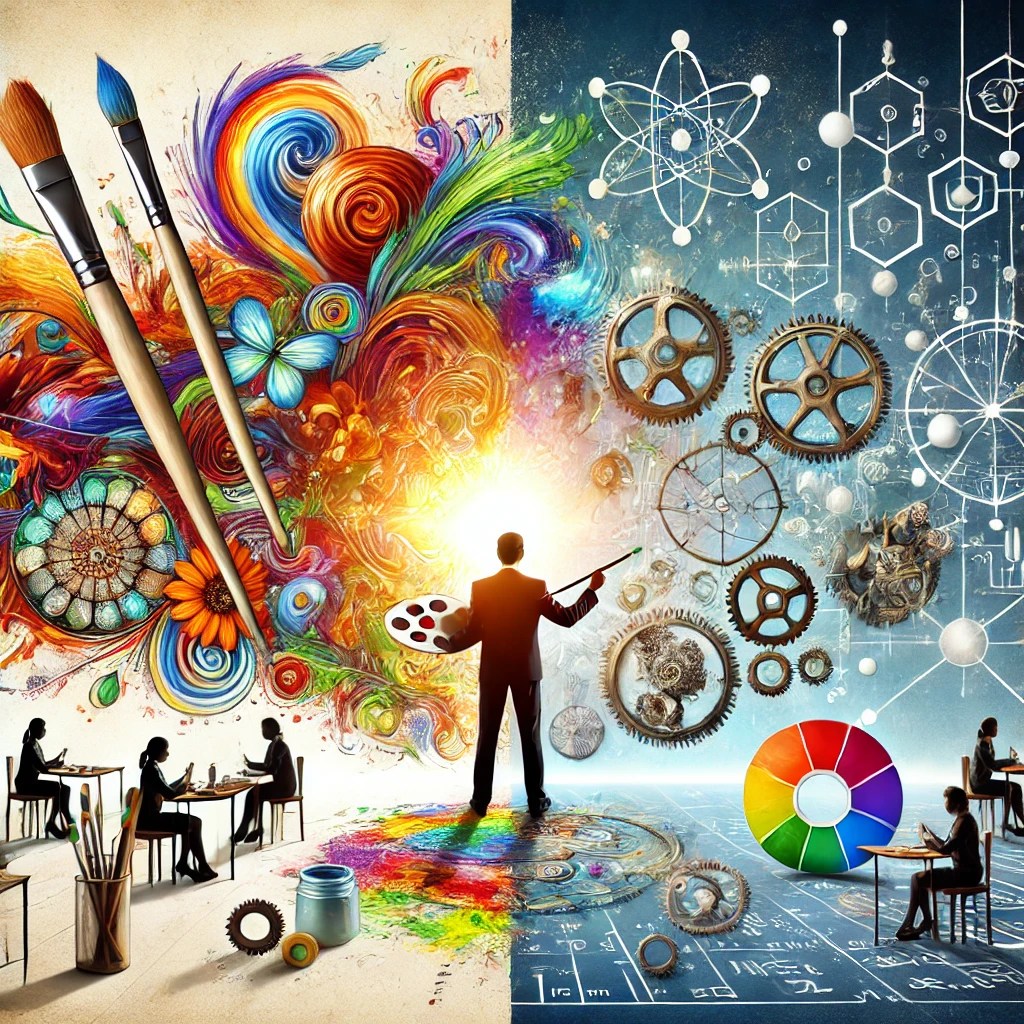
It’s critical to blend art and science when teaching. Fully understanding how these two worlds support each other is essential for developing a career in Teaching and Learning, whether in Training or Academia. “Teaching is an art. Improving teaching is a science.” I don’t know the origin of this quote, but I can’t take credit for it. However, I live by these words in my roles as an Instructor, Teacher Trainer, Instructional Designer, Educational Learning Designer, and in all the gray areas between these formal titles. Regardless of the specific title I hold, these two realms always apply, and I consistently consider both before teaching or training to achieve successful outcomes.
As an artist, I implement new teaching tools, such as Padlet, Mentimeter, and MS Forms. These technologies have the potential to be transformative learning tools—or mere timewasters. I pair these tools with activities from Liberating Structures, which help me move beyond conventional methods like group work or jigsaw activities (though these can be very effective when well-designed and applied). This is my artistic side at work. At the same time, I ensure these tools and activities are grounded in sound learning science so that I avoid creating mere “busy work.” For example, when I execute a Liberating Structures activity like TRIZ, I can see the underlying science of learning at play, spinning its gears just like a skilled doctor analyzing a patient’s needs.
The science behind learning comes from the courses I’ve taken, insightful conversations with academics, and the many books I’ve read. Foundational works such as e-Learning and the Science of Instruction by Clark and Mayer, Facilitating Learning with the Adult Brain in Mind: A Conceptual and Practical Guide by Kathleen Taylor and Catherine Marienau, and the open educational resource Theory and Practice of Online Learning (Anderson, 2011) have been especially impactful. These books provide a comprehensive understanding of learning theory and principles that apply to both online and in-class teaching. By reading just these three works, you’ll gain a solid grasp of the “why” behind the strategies outlined in an Instructor Guide. Every prescribed activity is deliberate, grounded in the science of learning.
When you merge the worlds of art and science, you’ll become a more confident and effective teacher or trainer, capable of helping your students consistently meet intended learning objectives. Take a moment to explore the reasoning behind the activities you’re already using—there’s often a robust scientific foundation underpinning your artistic teaching approach. These discoveries may lead to many “Aha!” moments as you uncover the science behind your craft.
 HKKS Education